During the fall and winter, many vacation homes remain unoccupied between family visits or reservations. While the first instinct might be to close the shutters and arm the security system against intruders, insurance statistics reveal another reality: in the mountains, the most frequent and destructive incidents are still caused by technical issues.
A sudden drop in outdoor temperatures combined with a heating system failure can turn a simple absence into a property nightmare. Water freezes in the pipes; metal or PER pipes burst under the pressure of the ice; and then, as the ice melts, it causes continuous flooding on oak floors or custom wood paneling.
To protect your cabin from freezing without relying on daily visits, technology now offers a discreet and autonomous solution. By integrating technical sensors into your security system, you transform your equipment into a sentinel dedicated to preserving your property.
The domino effect of a power outage in the mountains
Heavy snowfall on power lines early in the winter, a late October thunderstorm, or a temporary overload are enough to cause a micro-outage or trip the main circuit breaker.
In an empty vacation home, this event goes completely unnoticed. Yet it sets off a problematic countdown:
- The circuit breaker cuts off power to the boiler or heat pump.
- Even after power is restored to the community, many heating systems go into electronic safety mode and require a manual restart on-site.
- Without its frost protection, the cabin gradually loses its interior heat.
Depending on the property’s exposure and elevation, forty-eight hours of extreme cold are enough for room temperatures to drop below zero. Water then begins to freeze in the supply pipes, underfloor heating manifolds, and water heater tanks.
The temperature sensor: act well before the freezing point
Waiting for a pipe to burst before taking action is a costly mistake. Effective protection relies on early warning.
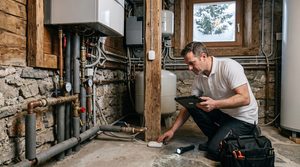
Placed in a representative room or directly in the utility room, the ambient temperature sensor continuously measures the temperature. As soon as the temperature exceeds a preprogrammed critical threshold—generally set at 7 °C—the sensor triggers a high-priority fault signal.
At 7 °C, the water remains completely liquid, and the structure suffers no damage. This safety margin gives you time to calmly organize a response to restart the boiler or reset the circuit breaker before freezing sets in.
These sensors operate autonomously on long-life batteries. Connected via secure radio waves to a control unit equipped with a multi-carrier SIM card, they transmit their alerts even if the home’s internet router loses power.
The Flood Detector: Stop the Leak at the First Drop
When the thaw sets in after a period of extreme cold, cracks caused by the expansion of ice release water under pressure. If the main water valve wasn’t shut off before you left, hundreds of liters can gush out every hour through floors and ceilings.
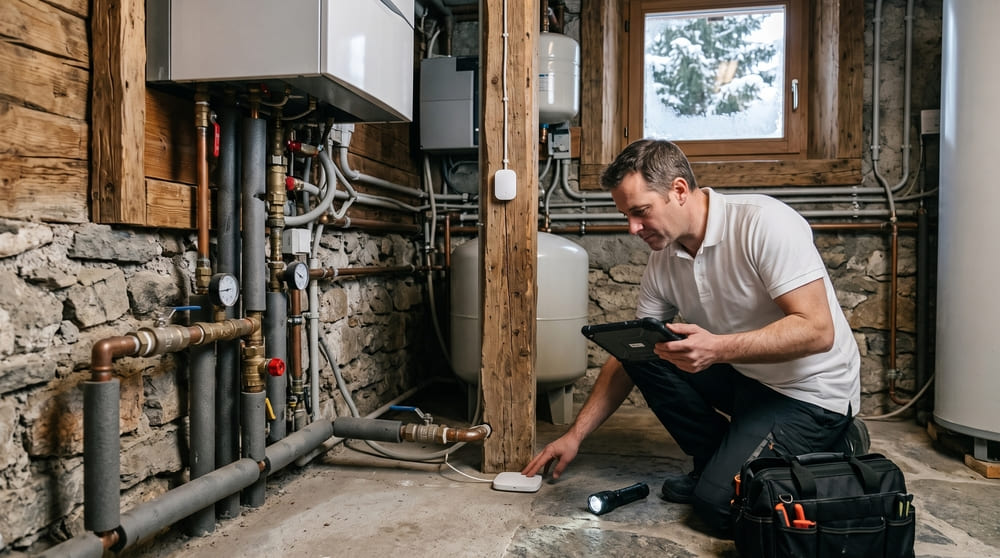
The water leak detector is specifically designed to address this risk. Installed directly on the floor near vulnerable areas—such as under the water heater, next to the distribution manifolds, in the laundry room, or at the base of the boiler—it features flush-mounted metal probes. As soon as a thin film of water, just a few millimeters thick, comes into contact with the probes, the sensor sends an instant emergency signal.
Detecting a leak within the first few seconds prevents water from soaking the floor slab insulation, damaging underground electrical circuits, or lifting solid wood floors. Some systems can even automatically activate a motorized solenoid valve to shut off the main water supply as soon as a leak is detected, stopping the damage at its source without human intervention.
Local Remote Monitoring: The Guarantee of Effective On-Site Action
It doesn’t solve anything if you’re hundreds of kilometers away or stuck on a plane. A technical alert requires the ability to take immediate action.
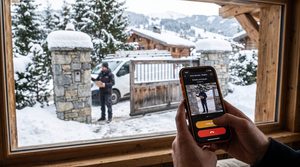
By connecting your sensors to a local remote monitoring service, you ensure the continuity of the emergency response chain 24 hours a day, 7 days a week:
- Our monitoring station immediately identifies the nature of the alert: an abnormal drop in temperature, a prolonged power outage, or confirmed water leakage.
- Our teams immediately notify your trusted service providers (heating technician, plumber) or your local property management office to arrange a visit without delay.
- If necessary, our on-site agents will visit your property to check access points, determine the source of the problem, and manually shut off the main shut-off valve before damage spreads.
This local coordination protects the value of your real estate assets against the harsh conditions of a mountain winter.
Conduct a technical inspection of your system before winter
Adding temperature sensors and flood detectors to an existing connected alarm system is a quick process that requires no major construction work or damage to your interior finishes.
Before the first frosts arrive, a technical inspection allows us to verify the sensors’ range, the condition of the batteries, and the proper functioning of communications with our monitoring center.
Contact our local team to equip your cabin against technical risks and freezing temperatures.